History of the Queen's Mill, Castleford
Queen's Mill, locally known as Allinson's Mill, was the world's largest stone grinding flour mill with twenty pairs of grinding stones. Although not a listed building the mill is of national significance because of its history, heritage and importance in the local community over hundreds of years. In fact archaeological evidence has found wheat grains on this site dating from the Roman period. According to the West Yorkshire Archaeological Society there has been a working mill by the River Aire as far back as Roman times.
Watermills, some dating from at least the twelfth century were established on both sides of the River Aire in Castleford.
AD 71 - 100
Archeological evidence of a granary and a quernstone which is a grinding stone for grain.
1122
Reference in church records to Castleford having two flour mills.
Pre 1600
Lands around River Aire in Castleford owned by the Crown (King / Queen).
1607
Castleford Mills sold from the Crown by Sir Arthur Ingram.
1695
Lands around Castleford, where the mills are located, are owned by Sir John Bland.
1699
Act of Parliament allows members of the Aire and Calder Navigation Co. to buy local land, mills and weirs in order to create a water link between Leeds and Wakefield.
Sir John Bland, MP for Pontefract receives £97,10s. p.a. for rental of the mills for a period of 47 years.
1766
Part of the current mill is built on the present site on the south bank of the river Aire.
1822
"Thomas Heptonstall / Thomas Heppenstall / Thomas Hepponstall / Thomas Heptinstall " is the main corn miller in Castleford.
Around this time there was another miller called Joseph Ramsden who works from "Castleford Mills".
1854
Richard Heptonstall is now the "miller & maltster" in Castleford. His name is recorded as Richard Heptinstall in 1855 where it remains consistent in other directories up to 1881.
1866
Building work completed so that most of the present mill is in place.
1884
Building plans show, current wheel and gear sizes and configuration in place.
1886
Record of a will for Richard John Heptinstall.
1887
Queen Victoria's Golden Jubilee.
The mill, which had been rebuilt many times up to this point, was most likely named after this event.
1888
Harry Goodall was named on the building plans which shows the wheel in it's present form in a 5 story building.
1896
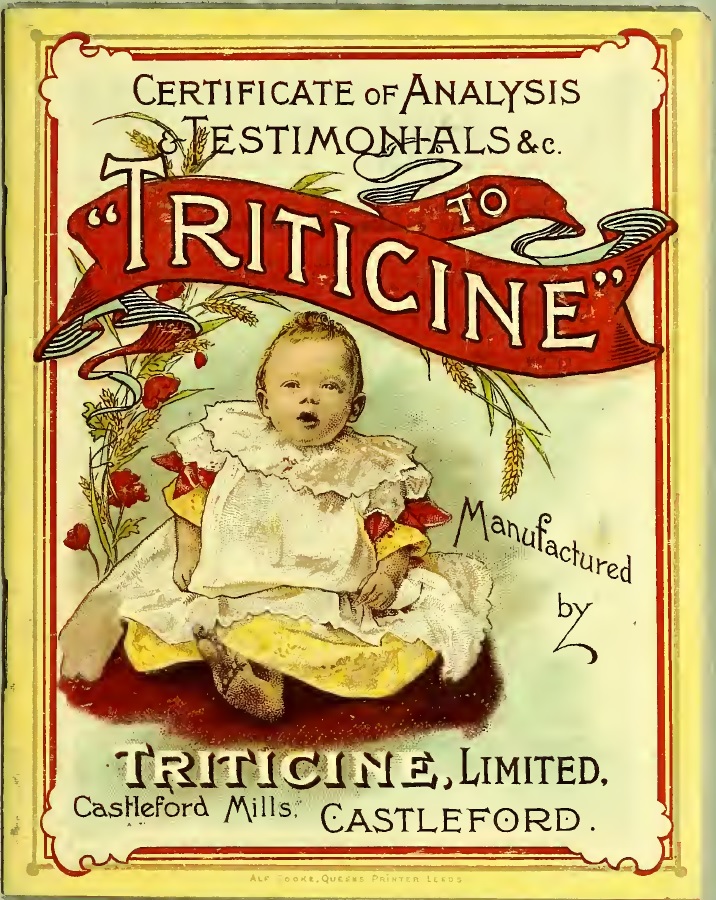
Harry and Joshua Goodall owners of "Goodall and Sons" and "Triticine Ltd." manufacture a food supplement Triticine. In the following years they have a number of legal cases to fight involving the patent on the name Triticine and payments to debenture holders.
1921
Allisons Ltd. which had got it's name from Dr. Thomas Allinson (1858-1918) now leases the mill.
1935
Allinson Limited joins 5 other companies to form "Allied Bakeries Ltd".
1939 - 45
14 sets of electrically driven mill wheels and an external silo, which could hold 600 tons of wheat, added to the mill thus making it the largest stoneground flour mill in the world.
1948
Queen's Mill taken back into public ownership by the British Transport Commission from "The Trustees of the Aire and Calder Navigation".
1962
British Transport Commission seperated off into departments so the mills now owned by British Waterways.
1972
Allinson brand taken over by Booker McConnell Ltd.
1978
Mill modernised so all the stones are turned by electric motors instead of the waterwheel, the gears of which are covered in concrete to conceal.
1994
Allisons sold to "Associated British Foods" whose subsidiary "Allied Mills" now lease the mill selling Allisons flour.
2003
American company "ADM" take over the running of the mill selling their own brand of flour.
2010
ADM close the mills.
2012
All of British Waterways assets and responsibilities are transferred to the Canal and River Trust.
2013
Castleford Heritage Trust buy the mill from Canal and River Trust.
2013
Castleford Heritage Trust open the mill to allow visitors to learn about its history and Trust's vision of the future.
2016
Castleford Waterwheel Project organised by the Castleford Heritage Trust